


SEO in 2026: What’s Changing, What Still Works & What You Should Do Next
SEO is changing. Fast. Search is no longer limited to just Google Search. Tools like ChatGPT are already shaping how people find information. But here’s what most people get wrong.
The core of SEO hasn’t changed. It’s still about helping people find the right answer.
At Zero Dimensions, we’ve spent the last 8+ years working on this closely. This blog breaks down what’s actually changing, what’s still working, and what you should focus on next.
What is SEO? (Explained Simply)
Most people think SEO is technical. But actually it is not. SEO is simply about helping people find the right information. This can be simply understood with a dictionary as an example. When you search for something, platforms like Google Search don’t instantly “know” the answer.
They scan through millions of pages and pick out the most relevant pages to show. That process is what SEO is built around. Now this is the same thing that is happening around AI platforms like ChatGPT. The only difference is how the answer is shown. But the goal is still the same, to give the users the best possible answer. So in case the content you create on your website is clear, useful, and relevant, it has a chance to show up.
That is SEO in its simplest form.
How Search Engines Actually Work
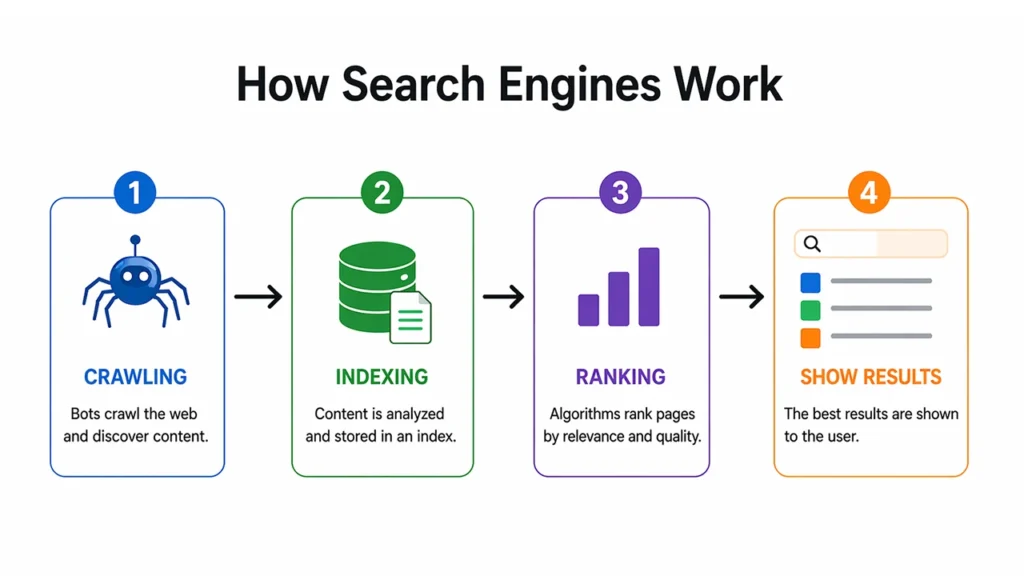
Before you try to rank, you need to understand one thing that search engines do not randomly show results. There is a process behind it that they actually follow. It happens in three simple steps.
The first one is crawling. Search engines like Google Search send bots to scan your website. These bots go through all the pages of the site and collect all the relevant information. In case if your website is not accessible, it won’t be seen.
The second step is indexing. Once your pages are found, they are stored in a database. Think of it like adding your page to a library. If your page is not indexed, it cannot appear in search results.
And the third is ranking. This is where things get competitive. Google looks at multiple factors like relevance, content quality, user experience, authority and a lot more and based on this, it decides where your page should appear.
Biggest SEO Myths You Should Stop Believing
There’s a lot of confusion around SEO. And most of it comes from outdated ideas. Let’s clear a few of them.
Myth 1: Once You Rank, You Stop SEO
This is one of the most common mistakes. SEO is not a one-time effort. Search results keep changing. Competitors keep improving. Algorithms keep updating. If you stop working on SEO, your rankings won’t stay the same. They will drop.
Myth 2: SEO for AI and Google is Completely Different
This is another big misunderstanding. The platforms may look different. But the goal is the same. Whether it’s Google Search or AI tools like ChatGPT, both are trying to give the best answer to the user. If your content is helpful, clear, and relevant, it can work on both.
Most people overcomplicate SEO. But in reality, the basics are still the same, which is to focus on the user, value and consistency. That is what works.
How Long Does SEO Take (Real Answer)
This is one of the most common questions that comes to mind when anybody starts SEO. There is no fixed timeline for SEO. Anyone who gives you an exact number is guessing.
SEO results depend on a few key factors.
1. Keyword Difficulty
If you are targeting highly competitive keywords, it will take time. Because many strong websites are already ranking there.
2. Competition in your Industry
Some industries are crowded. Everyone is investing in SEO. In such cases, ranking takes longer.
3. Your Current Website Strength
If your website is new, it will take time to build trust, and in cases where your website already has authority built, results can come out faster.
In some cases, you may start seeing movement in a few months. In others, it can take longer.
SEO in 2026: What Has Changed?
SEO today is not what it was a few years ago. A lot has changed. And most of it comes down to one thing. Content quality now matters more than ever.
Earlier, SEO was more about volume, which meant creating more content in form of blogs, pages, and using keywords. That approach worked for a while but not anymore.
Today, search engines are smarter. Platforms like Google Search are focusing more on relevance and user intent. They are not just looking at how much content you create, instead the focus lies on how useful and relevant content you create.
Another big shift is the rise of AI. Tools like ChatGPT have changed how content is created and consumed. People now expect faster, clearer answers. But this doesn’t mean SEO is getting replaced. It means the standards are getting higher. Low-effort content doesn’t work anymore. Copied ideas or generic information does not work anymore.
SEO is not ending. It’s evolving. And those who adapt to this shift will see the biggest results.
SEO in 2026: What Has Changed?
SEO today is not what it was a few years ago. A lot has changed. And most of it comes down to one thing. Content quality now matters more than ever.
Earlier, SEO was more about volume, which meant creating more content in form of blogs, pages, and using keywords. That approach worked for a while but not anymore.
Today, search engines are smarter. Platforms like Google Search are focusing more on relevance and user intent. They are not just looking at how much content you create, instead the focus lies on how useful and relevant content you create.
Another big shift is the rise of AI. Tools like ChatGPT have changed how content is created and consumed. People now expect faster, clearer answers. But this doesn’t mean SEO is getting replaced. It means the standards are getting higher. Low-effort content doesn’t work anymore. Copied ideas or generic information does not work anymore.
SEO is not ending. It’s evolving. And those who adapt to this shift will see the biggest results.
What Kind of Content Actually Works Today
Content is still the core of SEO. But what works today is very different from what worked earlier.
Earlier, content was about publishing regularly. More blogs meant better chances of ranking. But that approach doesn’t work anymore. Today, content needs to do one thing well. It needs to help the user.
Here’s what actually works now.
Educational content
Content that explains things clearly performs well. Not just surface-level information. But content that helps the reader understand something better.
Experience-based content
Generic content is everywhere. What stands out is real experience. Insights that come from actually doing the work.
Intent-driven content
Every search has a purpose. Some people want to learn, while other just want to compare and there are a very few who actually want to buy. Your content should match that intent.
If the intent is clear and your content matches it, your chances of ranking improve. The biggest difference from earlier is this. It’s no longer about writing more, instead it is about writing better.

AI Content & SEO: What You Need to Know
AI has changed how content is created. There’s no doubt about that. But it has also created a lot of confusion.
The biggest question people ask is simple. Can AI-generated content rank? The answer is yes. But not always.
AI is just a tool. What matters is how you use it. If you are using AI to copy what already exists, it won’t work. Search engines like Google Search can easily identify low-value content. And users can feel it too. But if you use AI to improve clarity, structure your ideas, or speed up your process, then it becomes useful.
The real factor is originality. Content that adds something new works. Content that repeats the same thing doesn’t.
This is true not just for Google, but also for platforms like ChatGPT. Both are trying to give better answers to users. So the focus should not be on “AI vs human content.” The focus should be on “valuable vs low-value content.”
If your content is helpful, clear, and original, it can perform well. No matter how it is created.
AI vs Google: Are They Competing?
A lot of people think this is a competition. AI vs Google. But that’s not really what’s happening.
What we are seeing is a shift in how people search. Not a replacement.
For informational queries, people are already moving towards AI tools like ChatGPT. They want quick, direct answers. No need to open multiple links.
But for transactional queries, things are different. When someone wants to buy something, find a service or compare options, they still rely on platforms like Google Search. Because here, trust and choice matter.
So it’s not AI replacing Google. It’s both exist together. Serving different types of intent.
Want to Understand This in More Detail?
This blog covers the key ideas. But the full conversation goes much deeper.
If you want a clearer, more practical understanding of everything we discussed,
you can watch the complete podcast here: