How to advertise tuition classes
Where parents look before they call, what to write in the ad, when to spend, and what the 2024 coaching rules say you can promise.
To advertise tuition classes well, be easy to find and easy to trust where parents look. Set up a complete Google listing and ask happy parents for reviews and referrals. Offer a demo class. Then, in the weeks before new batches, add paid ads aimed at parents near you. Say only what you can prove, because India’s coaching rules ban promises of marks or ranks.
Who chooses a tuition class, and how?
Working out how to advertise tuition classes starts with who decides. For school tuition, parents choose and pay, so your advertising has to convince them. Older students preparing for entrance exams have more say, but a parent usually still signs off on the fee.
Private coaching is common in India. A government survey of 57,742 students in 2025 found that 27% were taking or had taken private coaching that school year: 30.7% in towns and cities and 25.5% in villages. Urban families spent ₹3,988 a year per student on it on average (Ministry of Statistics, Comprehensive Modular Survey: Education, 2025). That also means you are rarely the only class on the street.
A typical parent hears a name from a neighbour or another parent, then looks it up. What they find in that search decides whether they call you or the next class:
- a Google listing with the right address, hours, photos and phone number;
- reviews from other parents, and your replies to them;
- clear facts: subjects, classes and boards, batch timings, and how to try a class.
The best ways to advertise tuition classes
There is no single best channel. The table compares the common ones by cost, speed and fit for a local class with one or two centres. Free channels come first. If you are working out how to promote tuition classes on a small budget, fill those before you pay for reach.
| Channel | Cost | How fast | Best for | Watch out for |
|---|---|---|---|---|
| Referrals and demo classes | Free | Slow to build | Every class | Only works if you ask for referrals on purpose |
| Google Business Profile and reviews | Free | Weeks | Parents searching nearby | Wrong address or hours; fake reviews break Google’s rules |
| WhatsApp updates to parents | Free | Immediate | Current and past parents | Message only people who gave you their number |
| Google Ads on local searches | Paid per click | Days | Admission weeks, new batches | Ads shown outside your area; no enquiry tracking |
| Facebook and Instagram ads | Paid | Days | Parents nearby who are not searching yet | Teen targeting is limited; aim at parents |
| Pamphlets, banners and newspaper inserts | Printing and distribution | One to two weeks | A small area around the centre | Hard to tell which one worked without a code |
| Tutor marketplaces and directories | Free or paid | Weeks | Home tutors and online classes | Your listing sits next to many others |
| Hoardings, radio and TV | High | Immediate | Institutes with many branches | Pays for people far outside your area |
Referrals and demo classes
A parent who is happy with their child’s progress is your most believable advert. Ask at a good moment, such as after a strong test or at the parent meeting. Make it easy: a short WhatsApp message they can forward, with your location pin and number. A free demo class gives the new family a low-risk way to try you.
Your Google listing
A Google Business Profile is free. It puts your class on Google Maps and in local results when someone searches for tuition near them. Google ranks these results on three things: relevance (how well the profile matches the search), distance and prominence (how well known the business is). Google says more reviews and good ratings can help, and that there is no way to pay for a better local ranking (Google Business Profile Help).
Use your real class name, the category that fits, your hours and real photos of the classroom. Reply to every review. If you want help with it, see our Google listing management.
Google Ads on local searches
Google Ads shows your class at the top of results when a parent searches words you choose, such as “maths tuition for class 10” with your area. You pay when someone clicks. Two settings matter for a local class. First, Google can show ads to people who are only interested in a place, not just people in it, so choose the location option for people in or regularly in your area (Google Ads Help). Second, set up enquiry tracking so you know which searches brought calls and forms.
Facebook and Instagram ads
Meta’s ads reach people by place and age even when they are not searching. Since February 2023, advertisers can reach teenagers only by age and location (Meta). For school tuition that is fine, because your buyer is the parent. Aim at adults within a few kilometres of your centre, and show the classroom, a teacher explaining a topic or a short demo.
Pamphlets, banners and newspapers
Printed adverts still reach parents who do not search online. Keep them local: housing societies, near schools where allowed, and newspaper inserts for your pin code. Put a QR code or a separate WhatsApp number on each one so you can tell which print run brought calls.
Is a Google listing worth it for a small class?
Yes. For a class with one centre, a well-kept Google listing is one of the cheapest ways to be found, because parents search for classes close to home and distance is one of Google’s three local ranking factors. It costs time, not money.
A full website SEO programme is a different decision. Ranking city-wide for broad searches against large coaching brands takes months of work. A small class rarely needs that. It needs a correct listing, steady reviews and one clear page with subjects, timings, fees policy and contact details.
An earlier version of this article (August 2024) said local search marketing “may not be worth it” for small tuition classes and quoted figures we could not trace to a source. We have corrected both.
What we have seen on an education listing
We have no tuition-class client yet, so we cannot show you a tuition result. The closest example from our own work is a higher-education campus. Zero Dimensions has managed the Google Business Profile of NMIMS Ahmedabad since at least May 2025, through two admission seasons. From June to October 2026 the profile recorded 1,449 direction requests, against 315 in the same months of 2025 (source: Google Business Profile).
| What Google counted | Jun–Oct 2025 | Jun–Oct 2026 | Change |
|---|---|---|---|
| Direction requests | 315 | 1,449 | +1,134 (+360%) |
| Calls | 110 | 310 | +200 (+182%) |
| Website clicks | 98 | 324 | +226 (+231%) |
| Profile views on Search and Maps | 18,022 | 39,006 | +20,984 (+116%) |
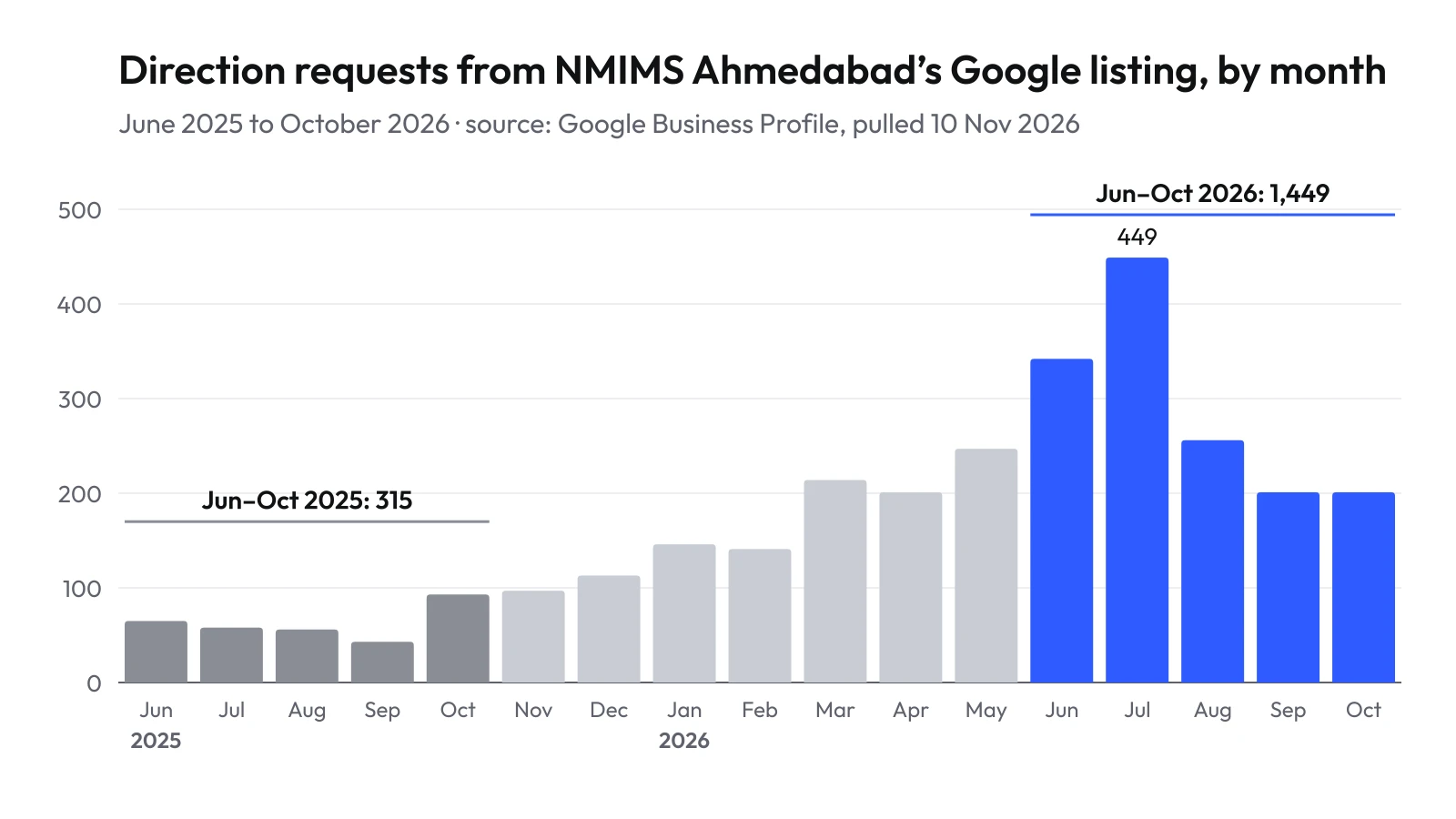
Two things here are useful for a tuition class. Calls peaked first, at 118 in May and 170 in June 2026, and direction requests followed, with 449 in July. On this listing, families rang before they visited, so have yours ready before your season starts. And the listing kept bringing visits after the peak, about 200 a month through September and October.
Read these figures with care. A higher-education campus is much larger than a tuition class, and we managed the listing in both periods, so this is not a simple before-and-after. Treat it as a picture of how families use a Google listing in admission season, not as a forecast for your class.
How to make an advertisement for tuition classes
A good tuition advert answers a parent’s first questions in a few seconds. Whether it is a pamphlet, a Google ad or an Instagram post, include:
- Subjects, classes and boards: “Maths and Science, Class 8–10, CBSE and GSEB”.
- Where: your area and a landmark parents know.
- When: batch days and times.
- How you teach: batch size, weekly tests, reports to parents. Only what is true.
- Who teaches: real qualifications and years of teaching, if you have them.
- One next step: book a free demo class, with a phone or WhatsApp number.
Here is a sample to adapt. Put your own landmark and number where the brackets are:
Maths and Science tuition, Class 8 to 10 (CBSE and GSEB)
Batches of up to 15 · weekly tests · a monthly report for parents
Evening batches, Monday to Saturday, near (your landmark)
Free demo class this week. Call or WhatsApp (your number).
The same checklist works for a home tuition advertisement. Say which areas you travel to, and whether you teach at your home or the student’s.
What can a tuition ad promise? The rules in India
India’s Central Consumer Protection Authority issued the Guidelines for Prevention of Misleading Advertisement in Coaching Sector, 2024 on 13 November 2024. They define coaching to include tuition, and they cover every form of advertisement by anyone who provides coaching. Under them, an ad is misleading if it:
- makes false claims about courses, duration, teachers’ credentials, fees or refunds;
- makes false claims about the number of selections, ranks or success rate;
- claims guaranteed selection or admission, or leads parents to believe that joining will ensure a good rank or high marks;
- creates a false sense of urgency, such as “only 3 seats left” when that is not true.
When you do show a result, the guidelines ask you to state the rank, the name and length of the course, and whether the student paid for it, next to their photo. Disclaimers must be in the same font size as the claim. You need the student’s written consent, taken after the result, to use their name, photo, testimonial or video.
The authority enforces this. In April 2025 it said that over three years it had issued 49 notices and fined 24 coaching centres a total of ₹77.60 lakh (Press Information Bureau). This is a summary, not legal advice; check the guidelines, and your state’s rules, before you publish.
| Don’t write | Write instead |
|---|---|
| “100% result guaranteed” | “Weekly tests and a monthly progress report for every parent” |
| “Guaranteed 90%+ in boards” | A true result with its details, for example how many of last year’s Class 10 batch scored above a mark, from the school results |
| A topper’s photo without permission | The photo, with written consent, their rank or marks, the course and its length, and whether it was paid |
| “Only 2 seats left!” on every post | The real batch start date and batch size |
When to advertise, and how much to spend
Spend most in the four to six weeks before new batches start, and keep the free channels running all year. For many school classes that means the months around results and the start of the school year, plus the run-up to board exams for revision batches. On the NMIMS listing, calls came before visits, so start before you expect the first enquiries.
There is no right budget, and we will not guess one for you. Work it out from what an admission is worth:
- Write down what one new student pays you in a year.
- Set a small daily budget for a two to four week test in one channel.
- Count enquiries and admissions from that test, then divide the spend by the admissions.
- Keep the channels whose cost per admission you can live with, and stop the rest.
On Google Ads, the daily budget is an average. On a busy day a campaign can spend up to twice it, but over a month you are not charged more than 30.4 times it (Google Ads Help). Plan with the monthly figure.
How to tell which advert brought the student
Advertising tuition classes without tracking means guessing next year. Keep it simple:
- Ask every new enquiry “How did you hear about us?” and write it down.
- Use a different QR code or WhatsApp number on each pamphlet run.
- Check your Google Business Profile’s performance report each month: calls, direction requests and website clicks.
- In Google Ads and Meta, count calls and form enquiries as conversions, and compare them with your register.
What isn’t worth it for most small classes
Some channels suit big institutes better than a class with one or two centres:
- Hoardings, radio and TV reach a whole city, so you pay for many families who will never travel to you.
- LinkedIn is built for work and business buying, not for parents choosing a tuition class.
- Cold email lists are hard to build and easy to ignore. Updates to parents who already know you are a better use of time.
- Long YouTube videos take real effort to make. Short clips of a topic explained well can work on Instagram and WhatsApp, as proof of how you teach.
None of these is wrong for every class. Test them only after the free channels and local ads are working.
Questions
How can I advertise my tuition classes for free?
Start with a complete Google Business Profile, then ask happy parents for a Google review and a referral. Offer a free demo class. Send updates on WhatsApp to parents who gave you their number. Put notices in housing societies where allowed. These cost time, not money.
How do I get more students for my tuition class?
Make it easy to find you and easy to try you. Keep your Google listing complete, collect reviews, ask for referrals after good results and offer a demo class. Before new batches, add a short burst of local ads, and reply to every enquiry the same day.
Can a home tutor have a Google listing?
Yes, within Google’s rules. If students come to your home, list that address and be there during the hours you show. If you travel to students, set a service area and hide your address. Use your real name or class name, as people know it.
Can I show toppers and their marks in my ad?
Yes, if it is true and you follow the 2024 coaching guidelines. Get the student’s written consent after the result. Show their rank or marks, the course name and length, and whether it was paid, in the same font size as the claim.
Should I use Google Ads or Facebook and Instagram ads?
Google Ads reaches parents who are searching for tuition now. Facebook and Instagram reach parents near you who are not searching yet. If you can afford only one, start with Google search ads in the weeks before new batches, because those parents are already looking.
What should a tuition ad include?
Subjects, classes and boards; your area and a landmark; batch days and times; how you teach; real qualifications; and one next step, such as booking a free demo class on WhatsApp. Leave out any promise of marks, ranks or selection.
When is the best time to advertise tuition classes?
In the four to six weeks before new batches start, and before board exams for revision batches. Keep your Google listing and reviews up to date all year, because parents search before they call.
Sources
- Results of the Comprehensive Modular Survey: Education, 2025, Ministry of Statistics and Programme Implementation, 26 August 2025.
- Guidelines for Prevention of Misleading Advertisement in Coaching Sector, 2024, Central Consumer Protection Authority, 13 November 2024.
- CCPA advises coaching centres to adhere to the 2024 guidelines, Press Information Bureau, 17 April 2025.
- Tips to improve your local ranking on Google and Guidelines for representing your business on Google, Google Business Profile Help.
- About targeting geographic locations and About overdelivery and your average daily budget, Google Ads Help.
- Continuing to create age-appropriate ad experiences for teens, Meta, January 2023.
- NMIMS Ahmedabad figures: the campus’s Google Business Profile, managed by Zero Dimensions, pulled 10 November 2026.